
Telnyx vs Twilio for HighLevel: What Changes at the Carrier Level
Telnyx vs Twilio for HighLevel 6 min read
LC Phone runs on Twilio. What actually changes if your HighLevel numbers run on Telnyx instead: voice rates, SMS pricing, number ownership, carrier tools and limits.
- Best for
- HighLevel teams that call a lot, want their numbers in their own carrier account, or need carrier-level tools like texting an existing landline, per-number health and numbers outside the US.
- Not for
- Teams that need 911, calling from the HighLevel mobile app, workflow texting on the new carrier today, or the simplest setup with nothing to connect.
- The difference
- Per minute, Telnyx voice costs less than half of LC Phone before any software fee, and the numbers sit in your own account. SMS pricing is close, and 10DLC rules are the same.
Every HighLevel sub-account already has a carrier: LC Phone, HighLevel’s built-in phone, runs on Twilio. So the real question behind “Telnyx vs Twilio for HighLevel” is whether moving your numbers from Twilio, through HighLevel, to Telnyx, in your own account, changes anything that matters. This article sticks to the carrier layer: rates, ownership, carrier tools and the rules that stay the same. For the app-by-app comparison, see Phone Clover vs LC Phone. For every way to run Telnyx with HighLevel, start with Telnyx for GoHighLevel.
LC Phone is Twilio, billed through HighLevel
LC Phone is not a separate carrier. HighLevel’s own documentation shows it: the SIP domain for
desk phones sits under sip.ashburn.twilio.com, and HighLevel’s pricing guide says its
rates match Twilio’s. When a sub-account turns on LC Phone, its numbers, minutes and texts run on
Twilio, inside HighLevel’s account, and HighLevel bills you.
HighLevel has no setting that points a sub-account at another carrier or a SIP trunk of your own. Using Telnyx means an app or integration outside the built-in phone. That is the choice this article weighs: Twilio through HighLevel, or Telnyx through your own account.
Voice rates: the clearest gap
Per minute, the difference is large. These are US rates: Telnyx’s list rate, paid to Telnyx, against LC Phone’s published rate.
| Per minute, US | Telnyx | LC Phone (Twilio) |
|---|---|---|
| Outbound calls | $0.0070 | $0.0166 |
| Inbound calls | $0.0052 | $0.01165 |
Rates as of Sep 2026. Rates change; check both before you decide.
At those rates, every 1,000 outbound minutes costs about $9.60 less in usage on Telnyx, and every 1,000 inbound minutes about $6.45 less. That is the carrier gap. It is not your total bill: Telnyx per-minute rates are well under LC Phone’s, but Phone Clover adds a software fee, so at light call volume LC Phone can cost less overall. Heavy callers save the most. The full cost picture is in what it costs on the pillar page and on pricing.
SMS pricing: close enough not to matter
Here is the plain version: on texting, the two carriers price about the same. LC Phone’s per-text rates sit close to Twilio’s own list price, and Telnyx’s are in the same range. If texting cost is your main reason to switch, it is not a strong one.
The fees around texting don’t disappear either. 10DLC brand and campaign fees are set by the carriers and apply on both. On Telnyx they are billed to your own account; on LC Phone, HighLevel adds a flat 5% to carrier, A2P and verified caller ID fees.
Whose account holds the number
This is the difference people notice least until they need it.
On LC Phone, your numbers are held inside HighLevel’s phone system. You manage them through HighLevel’s screens, and HighLevel bills you.
On Telnyx through Phone Clover, the numbers sit in your own Telnyx account, in your name, and Telnyx bills you directly. Phone Clover connects with an API key you create and can revoke. If you disconnect it, nothing is deleted: the numbers, their profiles and your call and message history stay in your Telnyx account, and you can see every number in the Telnyx portal.
That matters for agencies that want each client’s numbers under a clear owner, and for anyone who wants to be able to leave an app without losing the numbers customers call.
Carrier tools you get on your own Telnyx account
Owning the carrier account is what makes these possible. Phone Clover builds on Telnyx’s tools and shows them inside HighLevel.
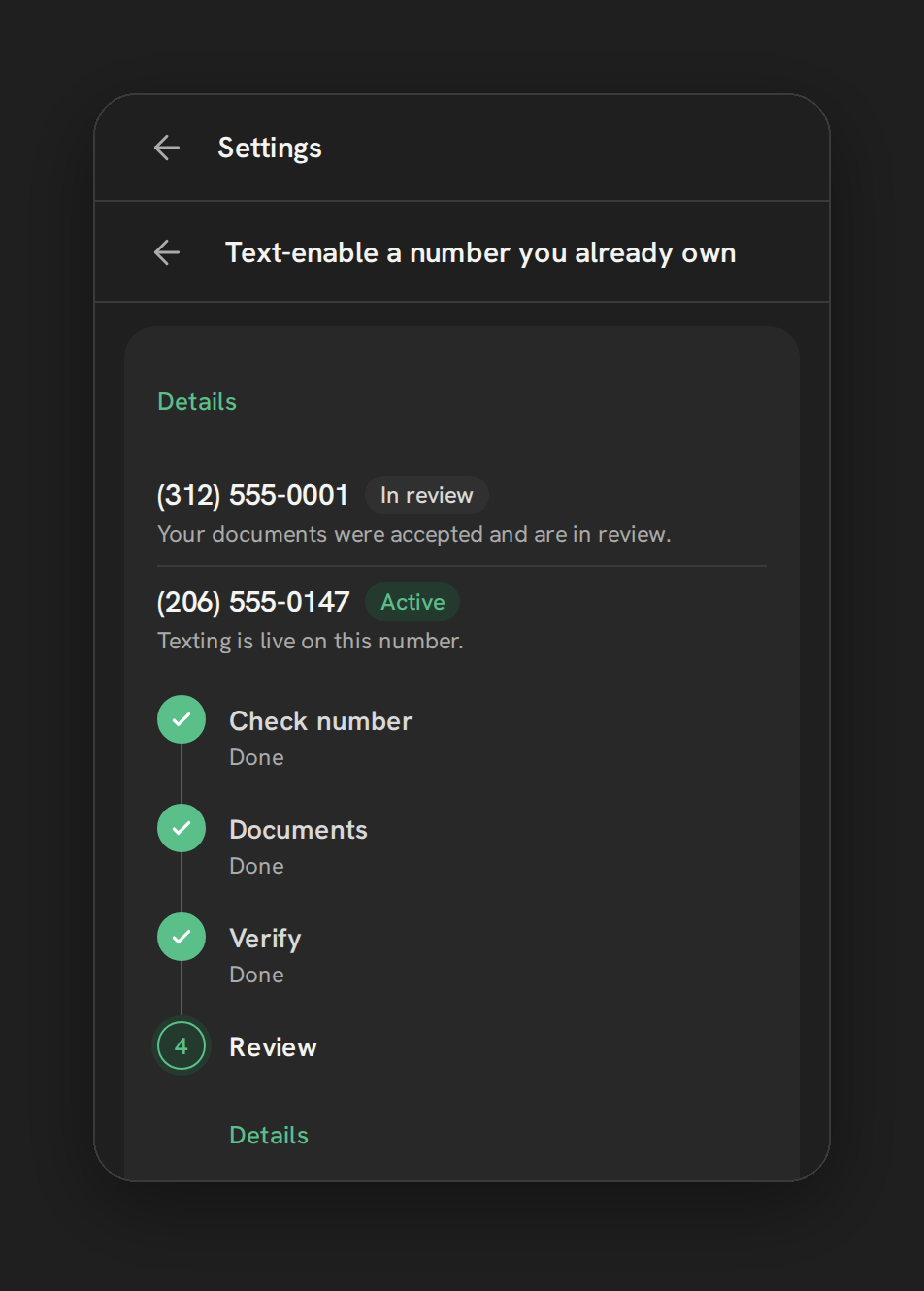
- Text from a number that lives elsewhere. Hosted SMS adds texting to a US landline or VoIP number you already own, without porting it; calls stay with your current provider. LC Phone doesn’t offer this as a self-serve option. Mobile numbers can’t be hosted this way. See the Hosted SMS guide.
- Caller ID name and STIR/SHAKEN, per number. You can see the CNAM on file and whether call signing is active for each number.
- Number health. Delivered and spam signals per number, a badge when one is flagged, and an optional switch that moves texting to a healthy number. LC Phone’s closest tool is a per-call spam lookup for US numbers. See number health.
- Plain reasons for failed texts. Instead of carrier error codes such as 30007, failures are grouped into reasons like “Blocked by a carrier” or “Opted out”, with an option to retry from another number. See failed-text reasons.
- Numbers in other countries. Search and buy numbers by country and type from inside HighLevel, on Telnyx’s inventory.
All five are ready today for every early-access account. What is not live yet is texting from HighLevel’s own Conversations, workflows, bulk texts and mobile app through Telnyx; that is coming next. For how the pieces fit together, see Texting.
What does not change
Some things are the same whichever carrier carries your numbers.
- 10DLC rules. US business texting needs a registered brand and campaign on Twilio and on Telnyx alike. The Campaign Registry and the carriers review both, and no carrier or app can promise faster approval. See A2P 10DLC for HighLevel agencies.
- Your compliance duties. Opt-in, do-not-disturb and calling-hours rules are yours to follow on any carrier.
- Spam labels. HighLevel’s own documentation says CNAM and STIR/SHAKEN do not remove nuisance or spam labels. On Telnyx you see more about each number, but nobody can promise a label goes away.
- Where outside calling lives. HighLevel’s developer documentation says outside call providers can log calls but can’t place or receive them in HighLevel’s native call screen. Any Telnyx setup uses its own calling interface; Phone Clover’s is a browser phone inside HighLevel, in early access. See Calling.
What you give up by leaving LC Phone
Moving your carrier through Phone Clover has trade-offs. The full list is on the pillar page; these are the ones that decide most cases:
- No 911. Phone Clover does not provide 911 or E911 on any number. Keep another line for emergencies.
- No calling in the HighLevel mobile app. Calls run in a desktop browser, and browser calling is in early access: it runs in our pilot account today and is switched on for each new account as we set it up. Incoming calls can forward to a mobile number.
- Native texting is not on Telnyx yet. Workflows, bulk texts and mobile app texting through Telnyx are coming next.
- More setup. A Telnyx account, an API key, 10DLC registration on that account and a second bill. Phone Clover is a private HighLevel app, not on the Marketplace, and we set it up with you. See How it works.
One more thing to keep in view: HighLevel staff have said publicly that more voice carriers may come to HighLevel natively. If that ships, the trade-offs above change.
Stick with Twilio, or move to Telnyx?
Stick with Twilio via LC Phone if:
- you want the simplest setup, with nothing to connect;
- your team needs to call from the HighLevel mobile app;
- you need 911 from your phone system;
- you need workflow, bulk or mobile texting on the new carrier today;
- your call volume is light, so a software fee would outweigh the per-minute savings.
Telnyx makes sense if:
- your team calls a lot, so the per-minute gap adds up;
- you want your numbers in your own account, in your name;
- you want to text from a landline or VoIP number customers already know, without porting it;
- you want to see which numbers carriers are flagging, and why texts fail;
- you need numbers in countries outside the US.
If you land on Telnyx, How to use Telnyx numbers in GoHighLevel walks through getting each kind of number in. If you are still weighing the two apps rather than the two carriers, read Phone Clover vs LC Phone.